
Painting Against Erasure
Rohingya artists in Cox's Bazar camps paint, sing, weave and teach children to preserve culture and memory as Myanmar rejects Rohingya identity.
Anowar Faruk worries about the children.
It isn't their lessons or their exam results. It's what they think is normal.
Faruk is a Rohingya artist. He was born in Arakan and crossed into Bangladesh in 2017. Most of the children he teaches were born here, in the camps of Cox's Bazar, and many of them, he told me, believe life is simply meant to look like this.
"They think our parents also lived in tarpaulin houses," he said. "They haven't seen how our houses were back in our country, how our traditions were. They think life is just like this. In tarpaulin houses. Crowded together."
Sit with that for a moment. If you have only ever known plastic roofs and narrow, crowded lanes, why would you picture anything else? The village pond, the open field and the family home in Arakan become stories that belong to someone else.
A name crossed out
In August, Myanmar's government put out a statement that read like routine paperwork.
It said it had checked 426,545 names from a list of 828,824 displaced people submitted by Bangladesh. Of those, it accepted 308,797 as former residents of Rakhine State.
What it would not accept was who they are. The statement called them "Bengalis" and rejected Rohingya as an ethnic identity.
On paper, it was a disagreement over one word, but a name is how a people's history gets written down. Once officials stop using it, it becomes easier to argue about where these families came from and whether they belonged anywhere at all.
More than a million Rohingya refugees now live in Bangladesh. Bangladesh, which never signed the UN Refugee Convention, officially calls them Forcibly Displaced Myanmar Nationals, or FDMN. The UN and most of the world call them refugees. The official label, notably, leaves out the word Rohingya altogether.
So I went to the camps with one question. When the state tries to erase you on paper, can you keep yourself alive on a wall?
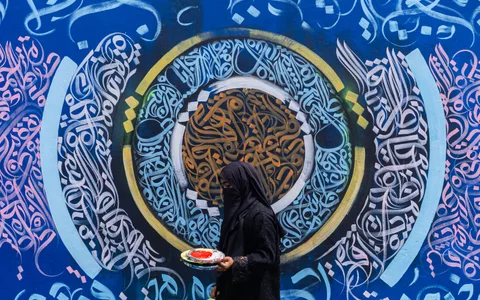
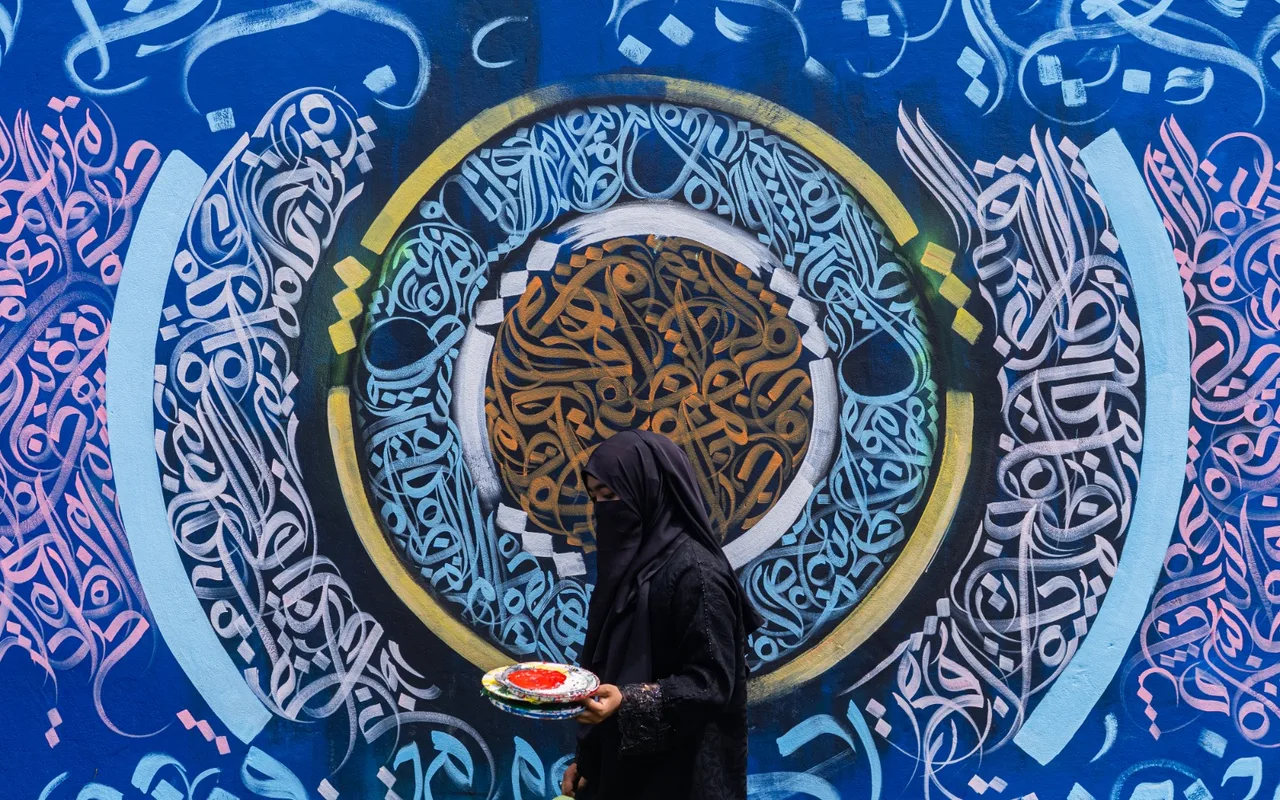
Artolution, a community arts organisation, has been working on a version of that question for years. It trains Rohingya men and women as artists and teachers. They paint murals, teach crafts, make music and try to hand what they remember to people too young to remember it.
Mohammad Islam, a Rohingya field coordinator, has been with the organisation since 2017. After the exodus, he said, people could see their community beginning to forget its culture.
"So that they do not forget the culture of our homeland, we show them their culture," he said.
A century on one wall
The fullest version of that idea is painted inside the Rohingya Centre in Camp 10.
The mural covers roughly a hundred years of Rohingya history. What struck me first was where it begins. It doesn't start with soldiers, or boats, or camps.
It starts with Rohingya men in parliament, serving as ministers and politicians. Then came traders, students at Sittwe University and families at home in Arakan. Before it shows you anything else, the wall wants you to see a community that once had representatives, schools, work and homes.
Then the story darkens.
One section shows rights being taken away, bit by bit. Farmers hand over part of their paddy as tax. The mural doesn't say who is collecting it, but the history behind it is well recorded. Farmers in Rakhine State were forced to sell rice to the authorities at far below market prices, and over the years Rohingya communities have faced arbitrary taxes and extortion from more than one power.
Then comes 2017: the violence, the persecution and the crossing into Bangladesh. After that, the present, with families squeezed into small shelters.
At the far end, the mural sets out four hopes. Freedom. A profession of your own choosing. The right to education. A way home to Myanmar.
None of these is a grand demand. That's exactly what makes them hard to look at.
Clay pots on the roof
As I walked further along the wall, the politics began to fade into the background. Most of the mural was simply about life back home.
One panel shows how Rohingya families prepared for storms and floods. Houses were built with disaster in mind.
In the dry season, big clay pots full of water sat on the rooftops. If a wooden roof caught fire, someone could throw a stone from a safe distance, break the pot and let the water pour over the flames. It was a fire extinguisher made from clay, water and common sense.
Further along, the wall turns to celebration. There's Eid, football and a cinema hall in Arakan. There's a paan shop. Children play tug of war. Men grapple in boli khela, the traditional wrestling. School sports day gets its own scene.
In one corner it is a full-moon night. Someone is reading aloud from a puthi, a traditional folk narrative, while someone else makes pitha.
Standing in front of it, I found it hard to think of the Rohingya only through what happened in 2017. I suspect that's the whole point.
What identity looks like
When I asked Faruk what makes someone Rohingya, he didn't reach for history or politics. He started with clothes. Back home, men wore the lungi and baju, and boys wore them to school as well. Then he moved on to food, the rice-flour pithas he grew up with, ludi pitha and pattok pitha.
"Every aspect of our lives is distinct," he said. "We portray these things through drawings."
Mohammad Amir, a mural artist, said you can see it in how the figures dress, and even in how they walk.
Mohammad Yunos, who teaches painting and clay modelling and spoke to us through an interpreter, said he paints the Myanmar flag and scenes from the homeland to show "where we come from and who we are".
For Samira, the memories are close and personal. She remembers the open fields and ponds in front of her house in Myanmar, and coming home from school to play games with names like Moldali.
"Over here, the spaces are so confined and small for playing," she said. "We can't play those games here."
The elders who sing
Murals are fairly new here. Songs are much older.
Nabi Hossain lives in Camp 18 in Balukhali. He writes verses and songs of sorrow and teaches them to children, in schools and in people's homes.
"Through songs, we want to make them understand where we are from," he said. "When we sing, we do it carrying a history for all Rohingya."
He told me he sings with tears in his eyes, holding on to the name of Arakan.
Mondu Mongar, an elder from Maungdaw, gathers children into song groups and tells them stories. He keeps returning to the same instruction: don't abandon your traditional clothes, don't abandon who you are.
"When we pass away, the children shouldn't abandon their identity," he said.
Their songs work like an archive nobody had to build. They carry places, memories and feelings that will never appear in any official document.
The shawl that pays
Some memories can even earn a little money.
Anowara, a handicrafts teacher, learned to make a traditional Rohingya shawl only a couple of months ago. Her teacher was an elderly Rohingya woman everyone calls “Dadi”. Moshiur Rahman, Artolution's project manager, introduced them.
The pattern looked difficult. But Anowara already knew sewing and thread work, so she made Dadi an offer.
"If you show me once, I can do it," she told her.
Most of the weaving was manageable. One knot was not. She learned that too, and within five or six days she had finished her first shawl. Now she teaches the technique to Rohingya girls and young women.
The numbers are small but real. The thread for one shawl costs about Tk700. Two trained women can finish it in roughly two working days, and a finished shawl can sell locally for up to Tk2,000. Take away the thread and that leaves about Tk1,300 for two women and two days of work.
That isn't much. But it's income, and the skill keeps travelling.
"Many people claim that the Rohingya have forgotten their past," Anowara said. "But that is not true."
Anowara has no interest in the shawl becoming a museum piece. She would rather see girls in the camp learn it, wear it and sell a few along the way.
A horse made from clay
If the elders are looking back, the children are mostly just playing. Maybe that's how it should be.
At a learning centre in Camp 19, a room full of children was working with coloured clay, rolling it into flowers, snakes, a pair of glasses, horses and elephants. One child made Spider-Man, which tells you something about the cartoons playing on phones in the camps.
Once the figures were ready, the children photographed them over and over, nudging them a little between each shot. Played back in sequence, the clay animals seemed to walk.
It's the most basic form of stop-motion animation. To a child watching their own elephant move, it's close to magic.
Yunos has a speech disability, and he says this work lets him say what words can't.
"Through my art and clay modelling, I can express everything inside me clearly," he said.
These sessions run alongside the children's regular lessons, and a lot of them seem to like the sessions more. Part of the reason is simple. Nobody is grading them. Nobody asks about yesterday's homework. A flower can look however a child thinks a flower should look.
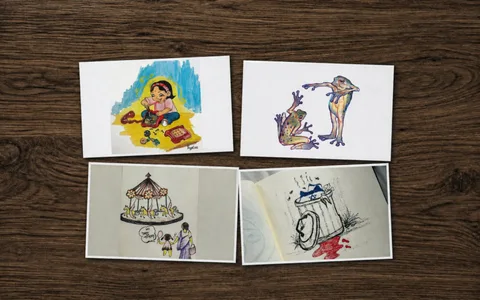
Anowara said the children get paper and pencils and are told to draw whatever they want. The artists help with technique. The ideas are supposed to come from the children.
Clothes from imagination
In another centre at Camp 17, the children were designing clothes.
They start with printed outlines of a boy and a girl, blank bodies waiting to be dressed, and fill them in with every colour, pattern and shape themselves. Later, the plan is to move from paper to real cloth, with needle and thread.
Artolution has a bigger dream for 2027, when it will be ten years since the exodus. It hopes to hold a fashion show where the children design their own outfits and walk the runway in them. The organisation is still looking for partners to fund it.
It sounds playful, and it is. But it also raises a question I keep coming back to. Give a child born in a refugee camp complete freedom to dress themselves, and what will they choose?
Something that looks like what their grandparents wore? Something they've seen in Bangladesh? Or something nobody has seen before?
A wall beyond the camps
Artolution's work doesn't stop at the camp fence.
At Darut Tawhid Islamia Girls Dakhil Madrasa in Nayapara, Teknaf, Rohingya and Bangladeshi artists painted the walls of a girls' madrasa together, and the students picked up brushes alongside them.
One mural, about 800 square feet, is about girls' education and women's progress. It ends with a broken chain, education snapping it open. The girls weren't just looking at a picture of their future. They were helping to paint it.
The other, more than 1,200 square feet, is about road safety. The madrasa sits beside a busy, dangerous highway.
We saw how dangerous it was on the way there. A bus had run off the road and into a field, and local people were pulling the injured out. After that, the helmets and traffic lights on the wall didn't feel like a routine awareness campaign. They felt like a warning.
Amir worked on that wall beside the students.
"We all came together, the Bengalis and the Rohingyas, and we worked on this wall," he said. The only real trouble was the monsoon. When it rained hard they stopped, and when the sun came out they started again.
Sherin Akter Ifa, a host community artist who works alongside Rohingya artists, said many Bangladeshis look down on the Rohingya without ever having spent time with them.
"If you don't mingle with them, you can never understand what kind of people they are," she said.
Here the usual roles flip for a while. The Rohingya artists aren't refugees receiving help. They're the ones bringing something to the community that hosts them.
So who decides?
It's worth being clear about how all this works.
Artolution chooses the broad themes and the projects. Most of its Rohingya artists weren't working as professional artists before they came to Bangladesh. The organisation trained them, and they now work on its projects for a monthly salary. For them, it is a job.
That means the artists don't fully control what gets painted. But the job has given them skills, an income and a sense of who they are.
Mohammad Nur wanted to be an artist from childhood. At school, when exams came, he would draw on the answer sheet instead of writing answers. When he joined Artolution about seven years ago, he found senior artists around him and decided it was his time to learn. He watched how they worked, how much they did and which colours they chose. Slowly, he says, he became the artist he had always wanted to be.
For Ela, the change was more personal. Before she joined, she spent long days alone at home, worrying about her parents, who were still in Myanmar.
"When I come to the office, I feel incredibly happy," she said. When she gets home, the worry returns, and she finds herself waiting for the night to pass so she can go back to work.
Nine years ago, she said, her community didn't support Artolution at all. She went door to door to explain it. Now people see the murals on camp walls and are amazed. "Do we have such art inside our Rohingya community?" they ask her.
An NGO can choose "Rohingya culture" as a theme. But it takes someone who lived that culture to know how a house was built, how Eid was celebrated, how a song was sung or how that one difficult knot is tied.
The agenda mostly belongs to Artolution. The memory belongs to the artists.
The take we did twice
There is a limit to that voice, and I saw it while interviewing Faruk.
I asked him about Myanmar's claim that the Rohingya are really Bengalis.
He answered carefully. His forefathers, he said, told him they were born in that country. If the Rohingya were really from Bangladesh, their customs, their dialect and their way of life would match those of Bangladeshis. They don't.
"Our ancestors were from Arakan," he said. "We too are from Arakan. We belong to that country."
Then we stopped recording.
The worry was that we had asked one man to speak for an entire people. If the clip went online, some in his community might criticise how he had said it. Talking about his own art was one thing. Talking on behalf of every Rohingya was something else.
So we recorded it again. The second time, Faruk talked about his art, his students and his murals.
Both takes matter. The first shows what he believes. The second shows how heavy it is to say it out loud.
For a stateless person, even a sentence about who you are can be a burden.
Is it enough?
None of this will get anyone citizenship or their land back in Arakan. A song won't make Myanmar's government start listening, let alone accept the word Rohingya.
The two sides aren't evenly matched. On one side are statelessness, displacement and a government that denies you exist. On the other are a few dozen artists, some learning centres, a handful of shawls and walls covered in paint.
Mohammad Islam knows that, but he is clear about what he wants the work to do. Through art, he said, the Rohingya can tell their own stories, show the persecution they faced and the problems they still live with.
"We can show the whole world our struggles and problems through our art," he said. His hope is that one day the community will go home and carry on the same work there.
Samira once dreamed of becoming a teacher. She never got the chance.
"I couldn't become a teacher," she said. "But through my art, I am teaching the people of our community, and I am turning them into artists as well."
When I asked how she wants to pass her memories of Arakan to the next generation, she talked about her nieces and nephews.
"We will surely return to Burma one day," she said. "Even if I don't go, my nieces, nephews and the younger children will go. So the dreams I couldn't fulfil, they will fulfil them."
Think about the alternative. A generation of children who believe the camps are all there ever was. An old woman taking the last knot of a shawl with her. A song that disappears because nobody asked the singer to sing it one more time.
Artolution's work may not be enough. A whole culture is a great deal to carry on a handful of walls.
But somewhere in a crowded camp, someone is asking an old woman to teach a knot, and asking an old man to sing a song. Someone is handing a child a pencil and saying: draw home.
At the very least, someone, somewhere, is trying.